
Skin Cancer Treatment & Reconstruction
Thoughtful surgical treatment and reconstructive planning with careful attention to health, function, and appearance.
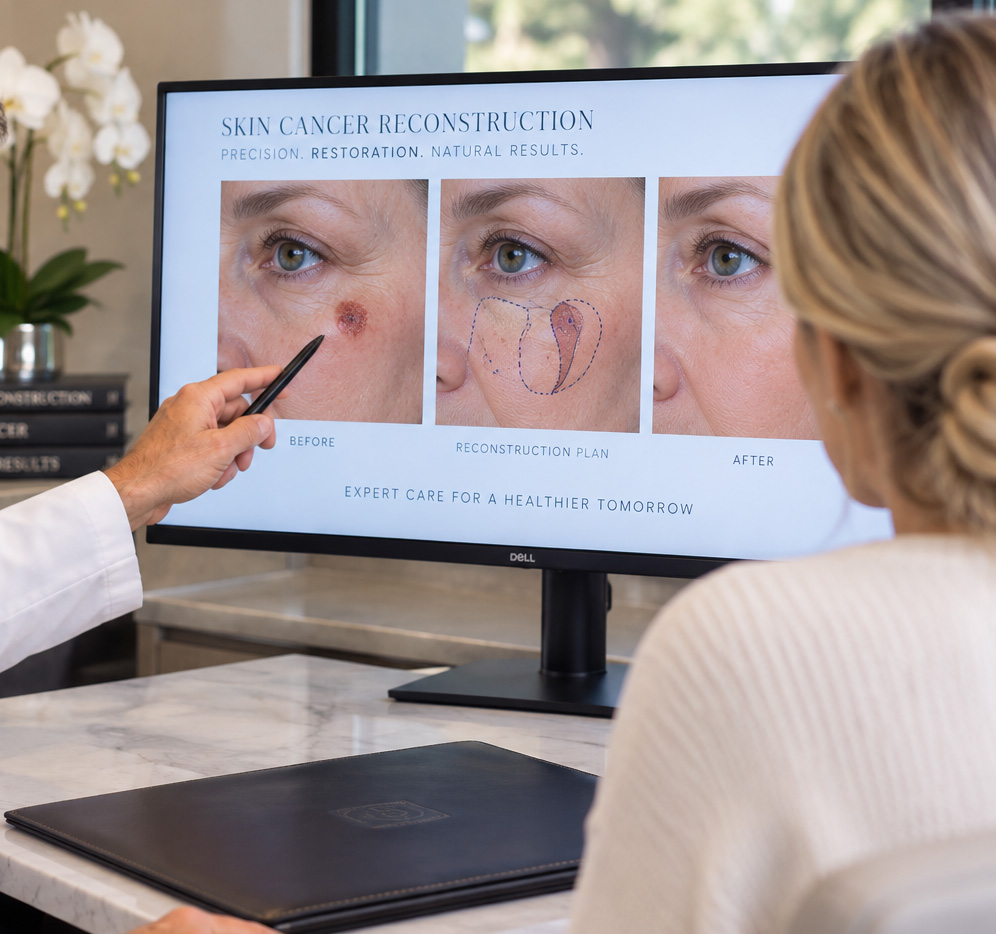
Treatment Is About More Than Removing a Lesion
A skin cancer diagnosis can be unsettling, particularly when the affected area involves the face or another highly visible part of the body.
The first priority is always appropriate treatment of the cancer. But once cancerous tissue has been removed, the resulting wound may also require careful reconstruction.
Dr. Charles Slack provides surgical excision and reconstructive care for appropriate patients. Depending on the diagnosis, treatment may also involve coordination with a dermatologist, Mohs surgeon, oncologist, or other specialist.
Three Major Types of Skin Cancer
Skin cancers differ considerably in their behavior, appearance, and treatment. An accurate diagnosis is essential before determining the appropriate treatment plan.
Basal Cell Carcinoma
Basal cell carcinoma, or BCC, is the most common form of skin cancer and frequently develops on areas with significant sun exposure.
It rarely spreads to distant parts of the body, but an untreated BCC can continue to grow and damage surrounding tissue.
Squamous Cell Carcinoma
Squamous cell carcinoma, or SCC, commonly develops on sun-exposed skin and can vary considerably in appearance.
Some squamous cell carcinomas have a greater potential to grow deeply or spread, making proper evaluation and treatment particularly important.
Melanoma
Melanoma develops from pigment-producing cells called melanocytes and is the most serious of the three major types because of its ability to spread.
Early melanoma is commonly treated surgically. More advanced disease may require multidisciplinary cancer care and additional forms of treatment.
The ABCDEs of Melanoma
The ABCDE guideline can help identify pigmented lesions that deserve professional evaluation.
One half looks different from the other.
Irregular, poorly defined, or scalloped edges.
Different colors or shades within one lesion.
Melanomas may be larger than 6 mm, but can be smaller.
A lesion changing in size, shape, color, or appearance.
A new, changing, bleeding, itching, or otherwise unusual lesion should be professionally evaluated.
Actinic Keratosis
Actinic keratoses are precancerous growths associated with ultraviolet damage from sunlight or indoor tanning. They frequently have a rough or scaly texture and may appear in different colors.
Not every actinic keratosis progresses to cancer, but some can develop into squamous cell carcinoma. Suspicious or persistent areas should therefore be evaluated by a dermatologist or other qualified medical professional.
A Spot That Doesn't Heal
Skin cancer does not always resemble a mole. A persistent sore, rough patch, shiny bump, firm growth, or area that repeatedly bleeds and heals deserves evaluation.
From Diagnosis to Reconstruction
The exact sequence varies by diagnosis, but skin cancer care often follows several distinct stages.
Evaluation
A suspicious lesion is evaluated and, when appropriate, biopsied to establish a diagnosis.
Cancer Removal
The cancer is appropriately treated using excision, Mohs surgery, or another treatment selected by the treating physician.
Clearance
When required, tissue margins are evaluated to help determine whether the cancer has been adequately removed.
Reconstruction
The resulting defect is repaired with consideration for function, anatomy, healing, and appearance.
Surgical Excision
For appropriate lesions, skin cancer may be treated with surgical excision. Cancerous tissue is removed along with an appropriate margin of surrounding tissue.
The removed tissue can then be evaluated by pathology to determine whether cancer cells are present at the margins.
The final surgical defect may be larger than the visible lesion because cancer can extend beyond what is apparent at the skin's surface.
Adequately Treat the Cancer
Reconstruction is important, but removing the cancer appropriately takes priority. Once adequate treatment has been achieved, attention can turn toward repairing the resulting defect.
Mohs Surgery & Reconstruction
Mohs micrographic surgery is a specialized technique used for certain skin cancers, particularly when preserving as much healthy surrounding tissue as possible is important.
During Mohs surgery, thin layers of tissue are progressively removed and examined until the evaluated margins are clear of cancer.
Depending on the circumstances, the Mohs surgeon may close the wound directly, or a plastic surgeon may become involved for reconstruction.
Rebuilding the Area After Skin Cancer Removal
Once the cancer has been appropriately removed, the reconstructive plan is determined by the defect rather than by a one-size-fits-all technique.
Size & depth of the defect
Location on the face or body
Available surrounding tissue
Nearby anatomical structures
Preservation of function
Scar orientation & appearance
Direct Closure
Smaller defects may be repaired by carefully bringing the surrounding skin together. When possible, the incision can be oriented with natural creases or anatomical boundaries.
Local Flap Reconstruction
A local flap moves nearby skin and tissue into the defect. Using adjacent tissue can provide a favorable match in color, thickness, and texture.
Skin Grafting
For certain defects, skin can be obtained from another area and transferred to the treatment site to provide coverage.
Complex Reconstruction
Larger defects or wounds involving important structures may require a more individualized reconstructive approach to restore contour and protect function.
When Millimeters Can Matter
Even a relatively small skin cancer can create a challenging reconstructive problem when it occurs on the face.
Facial structures have specific functional requirements. The eyelid protects the eye. The nostril must remain open. The lips need to maintain mobility and shape. The ear has complex contours that contribute to its natural appearance.
Reconstructive planning therefore considers much more than simply closing the wound.
What About the Scar?
Any procedure that removes skin creates a scar. The goal of reconstruction is therefore not to promise “scarless” surgery.
Instead, careful planning considers the position and direction of the scar, natural skin creases, tissue tension, and surrounding anatomy.
Scars also evolve. Early scars may appear red, pink, firm, or raised before gradually softening and becoming less noticeable.
Healing Continues Long After the Wound Closes
Although the initial incision heals much sooner, the appearance and texture of a scar can continue changing for many months.
Your Treatment & Reconstruction Plan
No two skin cancer defects are exactly alike. Dr. Slack evaluates the location, size, depth, surrounding tissue, and important nearby structures before recommending a reconstructive approach.
When another specialist is responsible for diagnosing or removing the cancer, care can be coordinated so that cancer treatment and reconstruction work together as effectively as possible.
Treat the medical problem appropriately while giving careful consideration to how you will look and function after treatment.
Skin Cancer Treatment & Reconstruction FAQs
Answers to common questions about excision, Mohs surgery, reconstruction, scars, and recovery.
Suspicious lesions often require evaluation and biopsy by a dermatologist or another qualified medical provider to establish a diagnosis. Dr. Slack's role may involve surgical excision in appropriate cases and/or reconstruction following removal of the cancer.
Mohs surgery is a specialized technique for removing certain skin cancers while evaluating tissue margins. Reconstruction is the process of repairing the wound that remains after the cancer has been removed.
Potentially, yes. Plastic surgeons may become involved after Mohs surgery when the resulting defect would benefit from specialized reconstruction. The appropriate arrangement depends on the location and complexity of the defect and the physicians involved in treatment.
Not necessarily. Some defects can be closed directly, while others may be repaired with nearby tissue using a local flap. Skin grafting is another option. The recommended approach depends on the defect's size, depth, location, and surrounding anatomy.
Yes. Any surgical procedure that removes skin produces a scar. Careful incision placement and reconstructive technique can help make the eventual scar less noticeable, and scars generally soften and fade as they mature.
Recovery varies according to the location and complexity of the reconstruction. Swelling, bruising, redness, and tightness may occur early in healing, while the scar itself can continue maturing for many months.
Yes. Recurrence risk depends on the type of skin cancer, its characteristics, and treatment. Patients who have had skin cancer should continue appropriate long-term surveillance with their dermatologist or other treating physician.
The ABCDE guideline—Asymmetry, Border irregularity, Color variation, Diameter, and Evolving—can help identify suspicious pigmented lesions. Any new, changing, bleeding, or otherwise unusual lesion should be professionally evaluated.
No. Treatment depends on the specific cancer and its stage. Surgery is commonly used for early melanoma, while more advanced melanoma may require multidisciplinary oncology care and systemic treatments.
Sometimes. In other circumstances, reconstruction may occur after margin clearance has been confirmed or following a separate Mohs procedure. Timing depends on the cancer, treatment method, defect, and physicians coordinating care.
Discuss Your Reconstructive Options With Dr. Slack
If you have been diagnosed with skin cancer and need surgical excision or reconstruction—or have been referred for reconstruction following Mohs surgery—schedule a private consultation in Allen, Texas.
Careful Treatment. Thoughtful Reconstruction.
Meet personally with Dr. Slack to discuss skin cancer excision, post-Mohs reconstruction, scarring, recovery, and the reconstructive options appropriate for your individual circumstances.
Schedule Consultation Allen, Texas · Serving Plano, McKinney, Frisco & North Dallas