
NeoGraft Hair Transplants
Restore thinning hair with advanced follicular unit extraction technology designed to create natural-looking results without the linear scar associated with traditional strip harvesting.
A Different Approach to Hair Transplantation
Hair loss can be a frustrating and emotional part of aging. For decades, hair transplantation was available, but older techniques often involved painful donor sites, noticeable linear scars, and results that could appear unnatural.
Follicular unit extraction, or FUE, changed that approach by allowing individual hair follicles to be harvested one at a time rather than removing a strip of scalp.
NeoGraft technology further advances FUE by providing a more precise and efficient method for harvesting individual follicular units while helping minimize trauma to the donor area.
What is Follicular Unit Extraction?
FUE involves harvesting individual hair follicles from the donor area and implanting them into areas where greater hair density is desired.
Identify Donor Follicles
Healthy individual follicular units are selected from areas of the scalp that provide suitable donor hair.
Extract Follicles
NeoGraft technology assists the hair restoration team in harvesting individual follicles without removing a strip of scalp.
Design the Hairline
Hairline design requires judgment and artistry to create a pattern that complements the patient's facial features.
Implant the Grafts
The individual follicles are carefully positioned to create a natural-looking distribution and direction of hair growth.
NeoGraft FUE Hair Restoration
NeoGraft combines technology with the judgment and artistry of the hair restoration team.
The system assists in harvesting individual follicles, but the planning of the hairline and placement of each graft remain essential to creating natural-looking results.
Benefits of NeoGraft Hair Restoration
The NeoGraft FUE approach is designed to minimize many of the drawbacks associated with older hair-transplant techniques.
Minimally Invasive
Individual follicular units are harvested rather than removing a strip of scalp.
Minimal Discomfort
Patients typically experience relatively little discomfort during and after the procedure.
No Stitches or Staples
The FUE harvesting process does not require closure of a long donor incision.
No Linear Scar
The procedure avoids the long linear donor scar associated with traditional strip harvesting.
Flexible Hairstyles
The absence of a long donor scar can make shorter hairstyles a more practical option.
Shorter Recovery
Many patients can return to work and normal activities relatively quickly.
Fewer Activity Restrictions
The minimally invasive harvesting method can reduce some of the limitations associated with older techniques.
Natural-Looking Results
Individual follicle placement allows the hairline and density pattern to be designed more naturally.
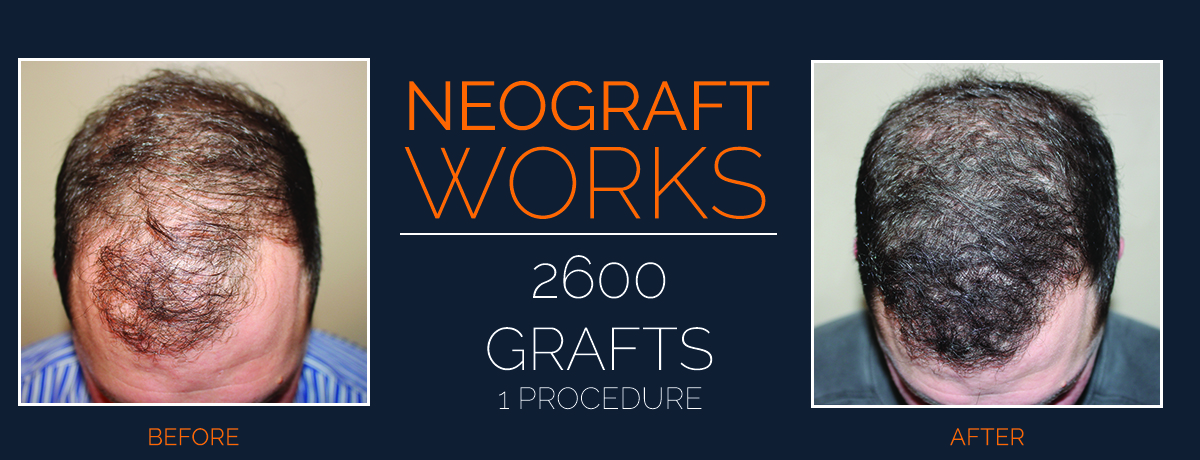
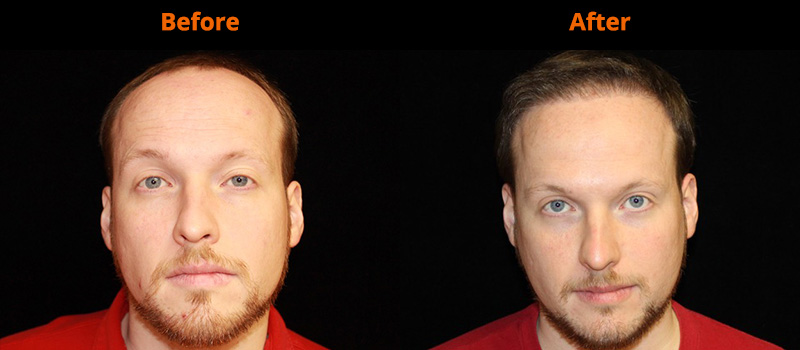
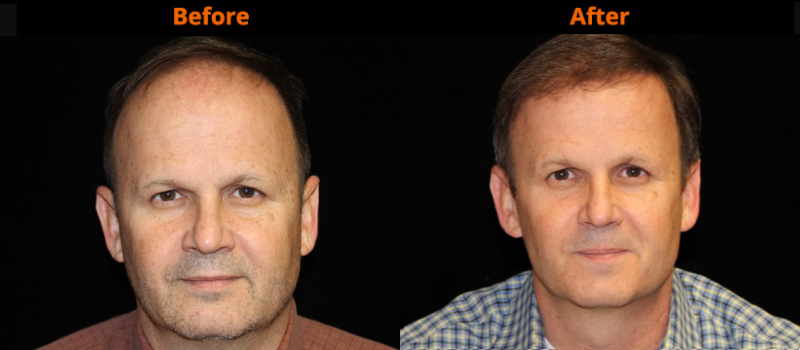
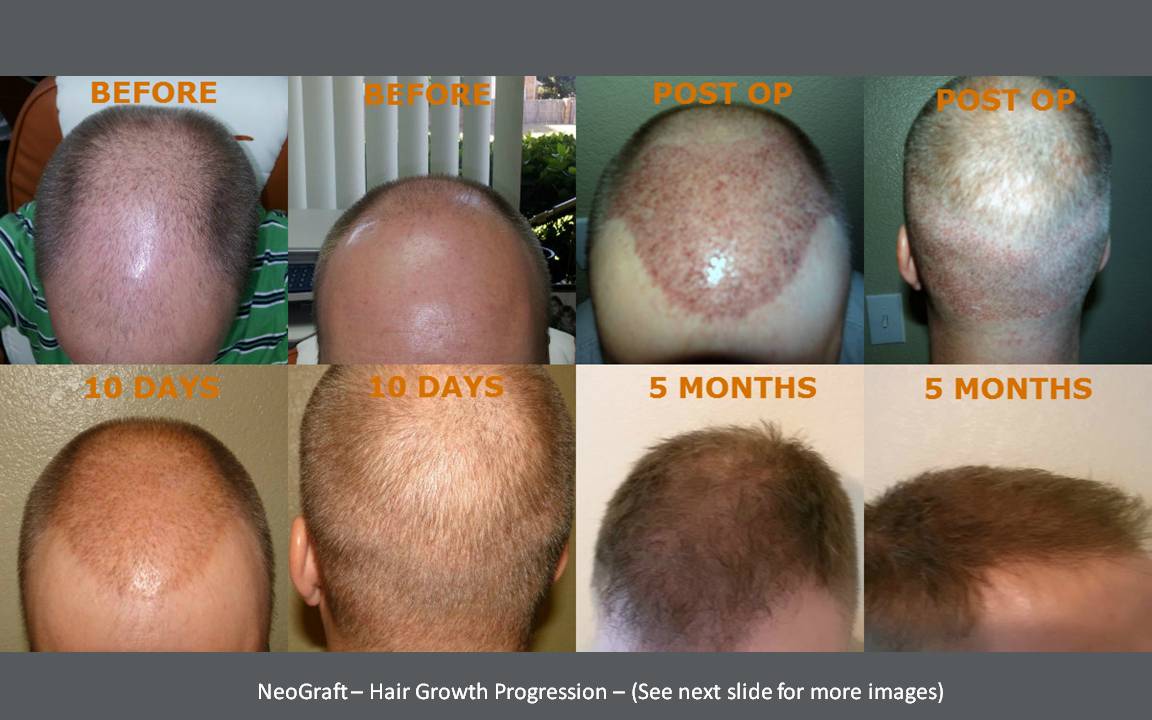
NeoGraft Before & After
Hair restoration develops gradually as transplanted follicles establish themselves and begin producing new hair.
NeoGraft is a Tool — Not a Robot
The NeoGraft system assists with follicular harvesting and implantation, but an automated system does not mean the procedure happens without human involvement.
The technology helps extract individual follicles efficiently, while the clinical team determines where those follicles should be placed.
The artistry comes from designing a natural hairline and creating the direction, angle, and distribution of the transplanted follicles.
Assists in precise, efficient harvesting of individual follicular units.
Guides hairline design, graft placement, direction, and overall aesthetic balance.

A Conservative Approach to New Technology
Dr. Slack does not adopt new procedures simply because they are popular.
Before offering NeoGraft, he researched multiple hair restoration options, spoke with physicians performing the procedures, and considered feedback from patients who had experienced them firsthand.
After evaluating the available options, he chose to offer NeoGraft to patients seeking a minimally invasive approach to hair restoration.
I take my time to do my research.
Dr. Slack Has Experienced NeoGraft Personally
Dr. Slack's perspective on NeoGraft goes beyond researching the technology and offering it to his patients. He has also undergone NeoGraft hair restoration himself.
In his personal story, he shares what it was like to experience the procedure from the patient's side — a perspective that adds another dimension to conversations about treatment, expectations, and recovery.
Read Dr. Slack's account of his own NeoGraft experience.
Read Dr. Slack's NeoGraft Story →NeoGraft Hair Transplant FAQs
Answers to common questions about FUE, results, recovery, and treatment planning.
What is NeoGraft hair transplantation?
NeoGraft is a technology-assisted follicular unit extraction (FUE) approach. Individual follicular units are removed from a donor area and placed in areas where greater hair density is desired.
How is NeoGraft different from traditional strip harvesting?
Traditional strip harvesting removes a strip of scalp and typically leaves a linear donor scar. NeoGraft-assisted FUE harvests individual follicular units without removing a strip, avoiding that type of linear incision.
Does NeoGraft leave scars?
NeoGraft FUE avoids a long linear donor scar, but individual extraction sites can leave small, usually less noticeable scars. Scar visibility varies with healing, hair length, and individual factors.
Is NeoGraft a robotic hair transplant?
No. NeoGraft is a tool that assists the clinical team with follicular harvesting. Hairline planning, graft selection, and placement still require clinical judgment and careful technique.
Will the results look natural?
Natural-looking results depend on hairline design, graft direction, distribution, donor-hair characteristics, and the extent of hair loss. Dr. Slack can discuss realistic expectations for your situation.
How long does it take to see hair transplant results?
Transplanted hair typically develops gradually over several months. Early shedding can occur, and the timeline and degree of growth vary by patient.
What is recovery like after NeoGraft?
Recovery depends on the number of grafts and your individual healing. Many patients return to routine activities relatively quickly, but the team will provide instructions for scalp care and temporary activity restrictions.
Am I a candidate for NeoGraft?
Candidacy depends on your pattern of hair loss, donor-hair supply, scalp health, medical history, and treatment goals. A consultation is needed to determine whether FUE is appropriate.
Can NeoGraft treat all types of hair loss?
Not every cause of hair loss is best treated with transplantation. The underlying cause and stability of hair loss should be evaluated before recommending surgery.
How many grafts will I need?
The number of grafts depends on the area being treated, desired density, and available donor hair. An individualized estimate can be discussed during consultation.
Find Out Whether NeoGraft Is Right for You
If you are dealing with hair loss, a personal consultation is the best way to determine whether NeoGraft or another approach may be appropriate.
Dr. Slack can discuss your hair-loss pattern, donor area, goals, and realistic expectations for treatment.
Ready to Learn More About Hair Restoration?
Meet personally with Dr. Slack in Allen, Texas to discuss your hair-loss concerns and whether NeoGraft may be an appropriate option for you.
Allen, Texas · Serving Plano, McKinney, Frisco & North Dallas